A Major Step Towards Exam Reforms: A New Era of AI and Computer-Based Exams
Super Admin··7 min read
A Major Step Towards Exam Reforms: A New Era of AI and Computer-Based Exams
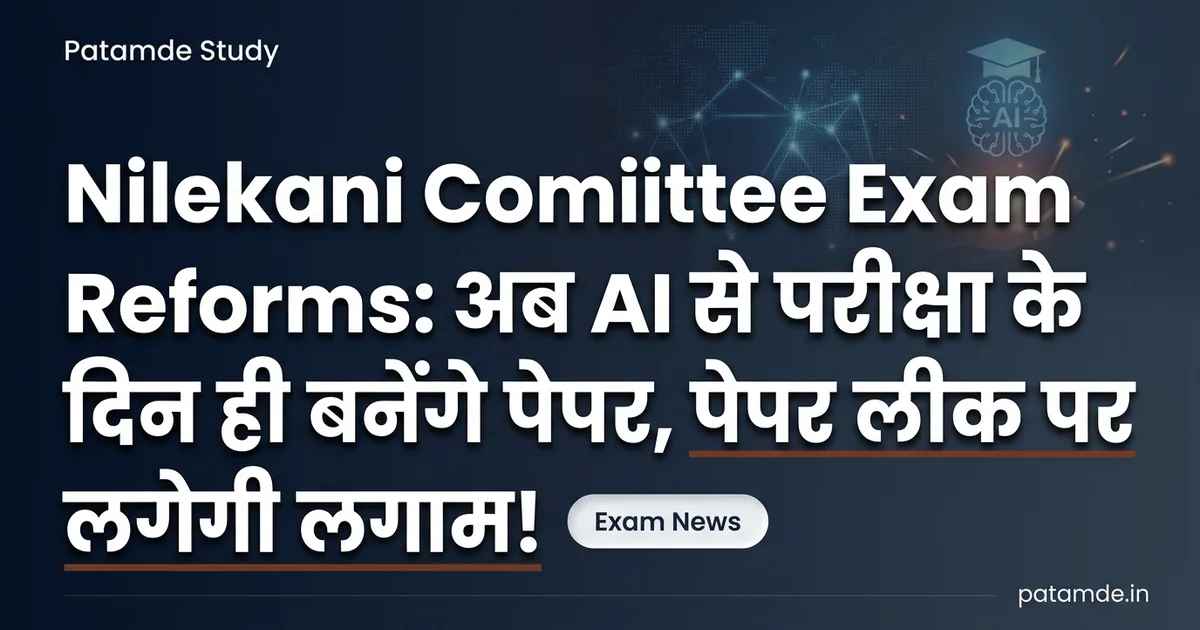
Serious questions have been raised continuously for some time now regarding the credibility of competitive exams in India. Incidents of paper leaks in NEET and other crucial exams have caused deep concern among crores of students and their parents across the country. To tackle this crisis and make the country's examination system completely secure, a highly revolutionary and modern proposal has been presented under the Nilekani Committee Exam Reforms constituted by the Central Government.
Infosys co-founder and chairman of this high-level committee, Nandan Nilekani, has suggested that all major exams in the country should be made completely computer-based (Computer-Based Testing - CBT) and the question paper should be prepared on the very day of the exam with the help of Artificial Intelligence (AI). This step could eliminate the hassle of traditional paper leaks forever.
Nandan Nilekani Committee's Revolutionary Proposal: The End of "One" Question Paper
Nandan Nilekani believes that the biggest reason behind paper leaks is the pre-preparation of a fixed question paper in the traditional examination system. Striking at the root of this problem during an event held in Delhi, he said:
"When no single fixed question paper exists before the exam, the economic incentive to steal or sell it will also disappear. Why do we even need to keep a question paper ready in advance to prevent paper leaks? Instead, we should create a massive Question Bank and generate the paper from it just before the exam."
When asked if the paper could be prepared with the help of AI on the exam day itself, he said in clear terms, "Yes, absolutely." Under this Dynamic Digital Assembly, the question paper will be prepared using computer programs and AI algorithms just a short time before the exam begins. This will minimize human intervention, leaving virtually no room for leaks.
Nilekani Committee: 50,000 Suggestions and Report Date
Following the NEET paper leak controversy, the Central Government constituted a high-powered task force on July 26 under the chairmanship of Nandan Nilekani. This committee has been entrusted with the responsibility of providing comprehensive suggestions to reform the structure, security, and administration of the examination system.
Under the Nilekani Committee Exam Reforms, the committee had sought suggestions from students, teachers, parents, and technical experts across the country. Several key developments have taken place under this process:
- Meetings: The committee has so far conducted 18 internal meetings and 40 consultation meetings.
- Suggestions: The committee has received over 50,000 valuable suggestions from across the country.
- Report Date: The Nandan Nilekani committee is likely to submit its final report on October 28.
Prime Minister Narendra Modi is also highly keen on implementing the decisions and suggestions of this committee at the earliest to restore the integrity of examinations in the future.
Expansion of Computer-Based Testing (CBT): Current vs. Future Requirements
Moving away from the traditional Pen-Paper Mode to a completely digital and Computer-Based Testing (CBT) system is the main pillar of this reform. However, implementing this in a vast country like India is a major structural challenge.
Currently, the facility to take exams via computer is available at approximately 1.5 lakh locations in India. However, to conduct all major national examinations on computers, this network will have to be expanded manifold. For this, the government will need to invest heavily in secure exam centers, high-speed internet, uninterrupted power supply, and robust IT security equipment.
Let us understand the difference between the traditional examination system and the proposed AI-based model through a table:
| Feature / Parameter | Traditional Exam Model | Proposed AI-CBT Model |
|---|---|---|
| Question Paper Creation | A fixed paper is prepared by experts several weeks before the exam. | Randomly generated from a massive Question Bank by AI and digital algorithms on the day of the exam. |
| Security Risks | High risk of leaks during printing, transport, and storage. | Stored on a digitally secure cloud, leaving no physical medium for leaks. |
| Economic Incentive | Brokers have the incentive to sell papers for lakhs of rupees. | Since there is no pre-existing paper, there is no economic basis left for buying or selling. |
| Medium of Exam | Primarily pen-and-paper (OMR sheet-based). | Completely Computer-Based Test (CBT). |
| Infrastructure | Exam centers in regular schools and colleges. | Digital centers equipped with secure IT tools, CCTV, and trained staff. |
What Will Be the Impact on 12 Million Candidates of NTA Exams?
The National Testing Agency (NTA) conducts some of the country's most prestigious and largest exams every year, such as NEET, JEE, CUET, and UGC NET. Approximately 12 million (1.2 crore) candidates appear for these exams annually.
If these proposals under the Nilekani Committee Exam Reforms are approved, it will directly impact these 12 million students:
- Relief from Mental Stress: The mental stress that students face due to the fear of paper leaks and exam cancellations will be completely eliminated.
- Change in Exam Pattern: Students will now have to adapt to Computer-Based Testing (CBT). Students from rural areas will need to practice basic computer usage.
- Fairness and Transparency: Every student will have the confidence that their hard work will not go to waste and the exam will be entirely merit-based.
Students will also have to change their preparation methods. Instead of just rote-learning selected important questions, a deep understanding of the entire syllabus will be essential, as the diversity of questions in an AI-generated paper could be much higher.
Challenges and Solutions Ahead for AI and Technological Reforms
Although this technology-driven approach seems highly attractive and effective, there are several challenges in implementing it in a geographically and economically diverse country like India:
1. Digital Divide
Access to computers and the internet is still limited in rural and remote areas of India. Taking computer-based exams could pose a major hurdle for students in these regions. To address this, the government will need to establish government computer exam centers at the district and block levels.
2. Difficulty Level Balancing
When AI randomly generates question papers, ensuring that the difficulty level of the paper is uniform for all students will be a major challenge. This will require advanced algorithms that can select questions in a balanced manner based on their difficulty index.
3. Cyber Security
While the risk of physical paper leaks will be averted, the threat of hacking and digital breaches could increase. This will necessitate the use of highly secure encryption technologies, closed-loop networks, and technologies like blockchain.
Conclusion: The Digital Future of the Indian Examination System
These changes suggested by the Nandan Nilekani committee could prove to be a milestone in the history of the Indian education and examination system. The correct use of technology will not only restore the integrity of exams but also secure the future of our youth. Ending the concept of "one question paper" and adopting "last-minute AI generation" is the need of the hour.
If you too are preparing for competitive exams and want to stay updated on the latest exam patterns, study materials, and strategies, connect with us at Patamde Study. We will keep you updated with every major change and exam update so that there is no hurdle in your preparation.