Anti-Cheating Law 2026: Strict Rules and Heavy Penalties for Paper Leaks and Cheating Mafias
Super Admin··6 min read
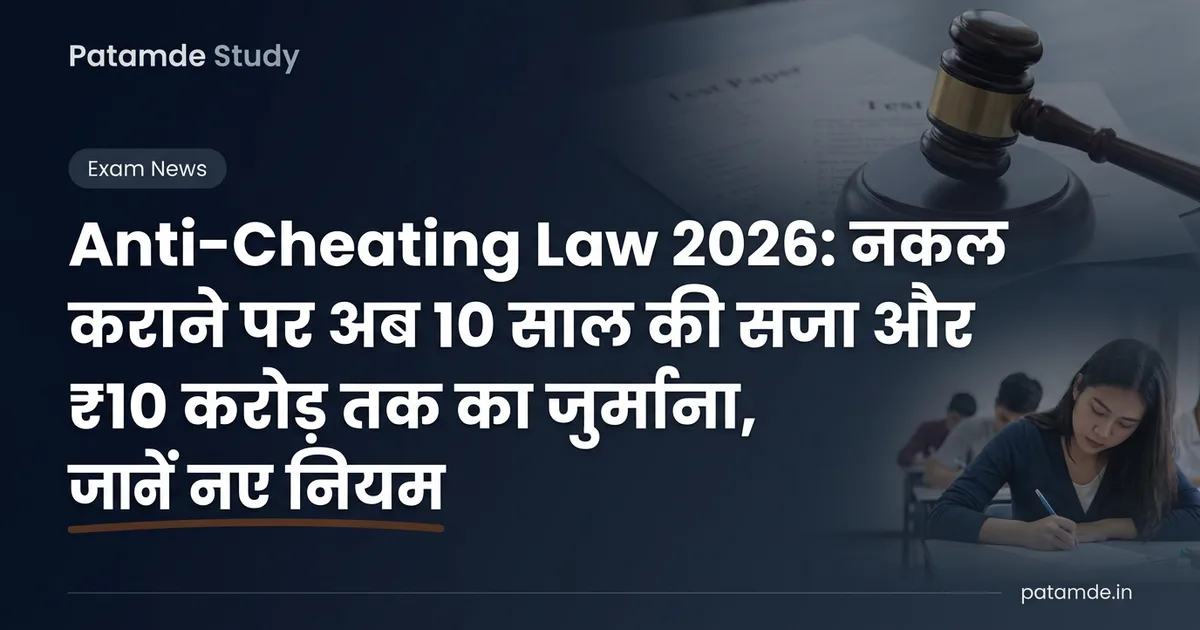
Anti-Cheating Law 2026: No More Mercy for Paper Leaks and Cheating Mafias, Central Government Tightens Rules
Every candidate preparing for competitive exams has only one dream—to secure a safe future on the strength of their hard work and dedication. However, in the last few years, paper leaks and cheating mafias have dealt a severe blow to the hopes of millions of honest students. To completely eradicate this serious problem and bring transparency to the examination system, the Central Government has taken extremely strict measures under The Public Examinations (Prevention of Unfair Means) Amendment Act, 2026 [1].
Following the implementation of this new law, offenders who facilitate cheating or use unfair means in examinations will now face up to 10 years in prison and a fine of up to ₹50 lakh [1]. Along with this, a heavy penalty of up to ₹10 crore has been prescribed to crack down on organized gangs [1]. The Department of Higher Education has sent the guidelines of this Act to the principals of all government and private colleges across the country, including Rajasthan, directing them to implement it strictly [1].
What is the Public Examinations (Prevention of Unfair Means) Amendment Act, 2026?
This new law has been introduced to make all major government recruitment exams and entrance exams of central educational institutions in the country completely secure and fair [1]. Under the scope of this Act, not only government jobs but also prestigious central institutions of the country will now be included [1].
For instance, entrance examinations of all central educational institutions in the state, including Jaipur's MNIT (Malaviya National Institute of Technology) and Ajmer's Central University of Ajmer, will now come under the purview of this strict law [1]. The main objective of this law is to completely break the nexus between exam-conducting agencies, officials, service providers, and external mafias [1].
Key Changes and Strict Punishment Provisions Under the New Amendment
The changes made in the Anti-Cheating Law 2026 have been mainly divided into five categories [1]. Through these changes, accountability has been fixed for individuals at every level associated with the examination system [1]:
1. Strict Action Against Service Providers
Heavy fines will now be imposed on the negligence or collusion of external companies and service providers that help conduct examinations [1]:
- Increase in Fine: The maximum fine imposed on service providers has been increased directly from ₹1 crore to ₹5 crore [1].
- Debarment: If any service provider is found involved in any malpractice, the period of debarring them from exam-related responsibilities has been increased from 4 years to 8 years [1].
2. Accountability of Involved Officials
Action harsher than ever before will now be taken against the collusion of government or private officials responsible for running the examinations smoothly [1]:
- Minimum Punishment: The minimum punishment for officials found involved in malpractices has been increased from 3 years to 5 years [1].
- Financial Penalty: The fine imposed on such officials has been increased from ₹1 crore to ₹5 crore [1].
3. Strong Crackdown on Organized Crime
The strictest provisions in the law have been made to completely dismantle large syndicates and organized gangs involved in paper leaks [1]:
- Minimum Punishment: The minimum punishment for those involved in organized crime has been increased from 5 years to 7 years [1].
- Historic Fine: The minimum fine in this category has been raised directly from ₹1 crore to ₹10 crore [1].
Comparative Table: Old vs. New Rules
You can easily understand the significant changes in the provisions for punishment and fines after the new amendment through the table given below [1]:
| Category / Type of Offense | Previous Provision (Old Rule) | New Provision (Amendment Act, 2026) |
|---|---|---|
| Punishment for Cheating/Unfair Means | 3 to 5 years in prison | 5 to 10 years in prison |
| Fine on Cheating Facilitators | ₹10 lakh | ₹50 lakh |
| Fine on Service Provider | Maximum ₹1 crore | Maximum ₹5 crore |
| Debarment of Service Provider | 4 years | 8 years |
| Minimum Punishment for Involved Officials | 3 years | 5 years |
| Fine on Involved Officials | ₹1 crore | ₹5 crore |
| Organized Crime Minimum Punishment | 5 years | 7 years |
| Organized Crime Minimum Fine | ₹1 crore | ₹10 crore |
Speedy Investigation and Justice System: STF and Fast Track Courts
It has often been observed that investigations into paper leaks or exam malpractice cases drag on for years, wasting the precious time of students. To solve this problem, a strict timeline has been set for investigation and court proceedings under the new law [1]:
- Investigation by Special Task Force (STF): In case of any malpractice in the examination, the newly formed Special Task Force (STF) will investigate the entire matter [1].
- 2-Month Timeline: According to the law, the investigation agency must complete its entire investigation and submit the report within just two months [1].
- Speedy Justice: For quick trial of the cases, they will be referred to Fast Track Courts [1]. Hearings in these courts will be conducted on a daily basis [1].
- Verdict in 3 Months: It has been made mandatory to deliver the verdict within a maximum of three months after the chargesheet is filed in court [1].
What Impact Will This Strict Law Have on Students and the Examination System?
Following this historic amendment, several positive changes will be seen in the country's examination system:
- Boost in Honest Students' Confidence: When paper leakers and cheating mafias know they could face 10 years in prison and crores in fines, they will stay away from such activities [1]. This will restore the confidence of students who work hard day and night.
- Timely Completion of Recruitments: With a set timeline of 2 months for investigation and 3 months for court verdicts, recruitment processes will not drag on for years [1].
- Credibility of Institutions: The credibility of entrance examinations of prestigious institutions like MNIT and central universities will be further strengthened [1].
Important Fact: To prevent cheating in public examinations, including competitive exams, an anti-cheating bill had previously been introduced in the Rajasthan Legislative Assembly [1]. Now, with this new amendment by the Central Government, a uniform and extremely stringent law has been implemented across the entire country [1].
Prepare Securely and Honestly with Patamde Study
When such strict steps are being taken to make the examination system completely transparent and secure, now only your true hard work can bring you success. Instead of falling for any shortcuts or traps, give your preparation the right direction.
At Patamde Study, we provide you with accurate study material, latest exam updates, and excellent preparation strategies for all major national and state-level competitive exams. Strengthen your preparation by joining us and make your dreams come true with complete honesty.
Conclusion
The Public Examinations (Prevention of Unfair Means) Amendment Act, 2026 is a revolutionary step toward cleaning up India's education and employment system [1]. These strict measures taken by the government—such as up to 10 years in prison, fines up to ₹10 crore, STF investigation, and fast-track court timelines—will certainly break the spirits of the cheating mafia [1]. The time has come for students not to be misled and to rely solely on their merit. Stay connected with Patamde Study for your exam preparation and the latest educational news.