NTA Reforms: Parliamentary Committee's New Recommendations and Their Significance
Super Admin··6 min read
NTA Reforms: New Recommendations of the Parliamentary Committee and Their Significance
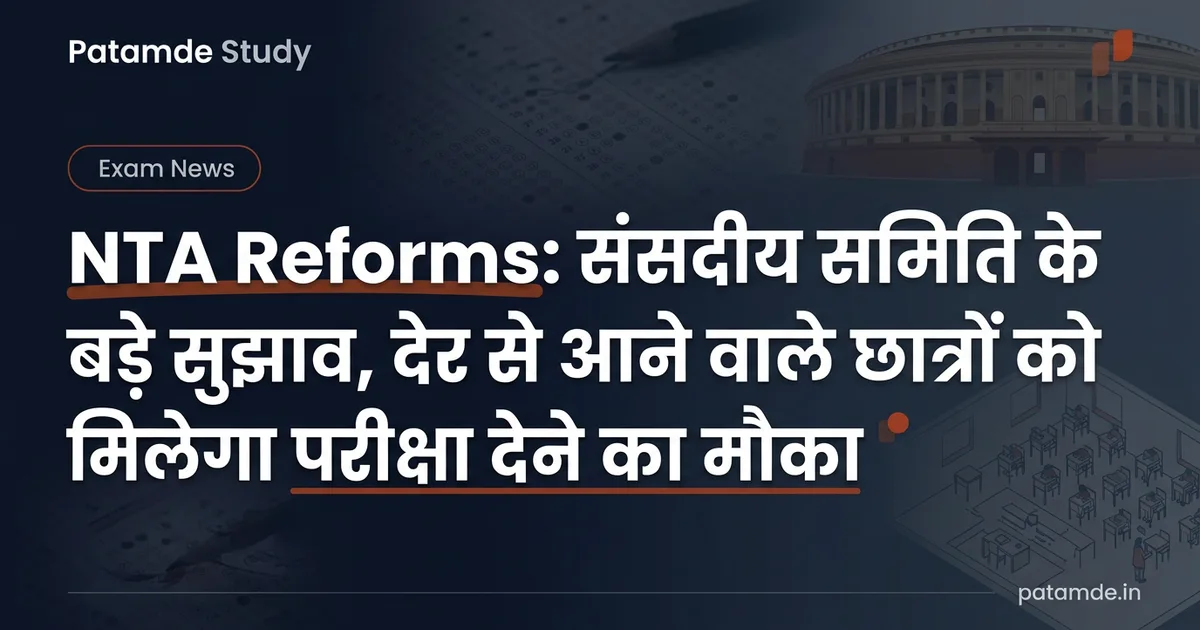
Major changes are underway for the National Testing Agency (NTA), which conducts the country's largest and most important competitive exams. The Parliamentary Committee has recently given several revolutionary and student-friendly suggestions regarding NTA Reforms [image.png]. According to this report, which came to light on October 10, 2026, in Jaipur, candidates who arrive late for exams due to some reason may now also get an opportunity to take the exam [image.png].
Demands for these reforms have been rising for a long time, given the paper leaks and shortcomings in exam management [image.png]. The main objective of these changes suggested by the Parliamentary Committee is to make the country's examination system more transparent, secure, and student-friendly [image.png]. In this article, we will analyze in detail all the key suggestions made by the Parliamentary Committee and their potential impacts.
Relief for Late-Arriving Candidates: Entry Allowed with an Affidavit
It is often seen that due to traffic jams, train delays, or other unforeseen reasons, students arrive at the exam center a few minutes late. Due to the strictness of the current rules, they are not allowed entry into the exam center, which wastes their entire year.
As a precise solution, the Parliamentary Committee has suggested that allowing late-arriving candidates to sit for major exams, including NEET, should also be considered [image.png].
Important Suggestion: According to the committee, a written affidavit/undertaking can be taken on the spot from such candidates, after which they can be allowed entry into the examination hall [image.png]. This step will save students from immense mental stress and secure their future.
Major Changes in the Examination System: Two-Stage Exams and Separate Mains
The Parliamentary Committee has also recommended major changes in the way exams are conducted [image.png]. Currently, due to single-stage exams, there is excessive pressure on the administrative framework, which increases the chances of discrepancies. The committee has given the following suggestions:
- Two-Stage Examination System: The possibility of a two-stage (Preliminary and Mains) system should be explored for large and major exams [image.png]. This will not only make the final selection more precise but also make it easier to manage security arrangements.
- Separate Mains Exam for Specific Fields: The idea of conducting separate mains exams for courses like MBBS, Nursing, and AYUSH has been introduced [image.png]. This will allow a better evaluation of candidates' eligibility for each specific field.
- Limit on Age and Attempts: It has also been recommended to consider setting a reasonable and logical limit on the age and attempts of candidates in major exams [image.png].
Crackdown on Paper Leaks: Strict Steps to Increase Security and Transparency
The biggest focus in the direction of NTA Reforms is centered on preventing serious problems like paper leaks [image.png]. To maintain the confidentiality and integrity of the exams, the committee has proposed strict security arrangements:
1. Increase in the Number of Government Exam Centers
Currently, many exams are conducted in private computer centers or colleges, where there remains a possibility of lapses in security standards. The committee has recommended that the number of government exam centers across the country should be rapidly increased so that exams can be conducted in a completely secure environment [image.png].
2. Promoting Computer-Based Tests (CBT)
Compared to traditional pen-and-paper-based exams, the risk of paper leaks is significantly lower in computer-based tests. Therefore, the committee has emphasized expanding the scope of computer-based exams further [image.png].
3. Recruitment of Permanent Staff and Accountability
With a high number of employees working on deputation or contract in the NTA, it is difficult to fix accountability. The Parliamentary Committee has laid special emphasis on recruiting permanent staff in the agency [image.png]. Along with this, a suggestion has also been made to establish the direct accountability of NTA to the Parliament [image.png].
Help to be Taken from Experts of IITs, AIIMS, and IIMs
Help from experts of the country's top institutions will be taken to make the quality and security of question papers world-class [image.png].
- Participation of Top Institutions: Help from experts of IITs, AIIMS, and IIMs will be taken in question paper formulation and exam management [image.png].
- Checking Conflict of Interest: The complete credibility of the experts setting the question papers will be verified, and it will be ensured that they have no personal or professional 'Conflict of Interest' [image.png].
- Dynamic Question Bank: To prevent paper leaks, a large and constantly updated (Dynamic) question bank will be prepared [image.png]. This will make it easier to prepare a set of new and unpredictable questions every time.
- Action Against Tainted Service Providers: A blacklist of service providers involved in discrepancies in the examination process will be prepared to keep them away from any exam-related work in the future [image.png].
Comparative Overview of Key Suggestions of the Parliamentary Committee
The table below provides a brief overview of the key reforms suggested by the Parliamentary Committee and their objectives:
| Current Challenge / Problem | Proposed Reform by Parliamentary Committee | Potential Positive Impact |
|---|---|---|
| No entry on late arrival | Entry allowed with a written affidavit [image.png] | Students' year will be saved from being wasted and mental stress will be reduced [image.png]. |
| Security lapses at private centers | Increase in the number of government exam centers [image.png] | Security and transparency at exam centers will increase [image.png]. |
| Paper leaks and lack of security | Large and constantly updated question bank [image.png] | Paper leak incidents will be completely curbed [image.png]. |
| Dependence on contract staff | Recruitment of permanent staff and accountability to Parliament [image.png] | Confidentiality and administrative control within the agency will be strengthened [image.png]. |
| Heavy pressure of single exam | Conducting two-stage exams and separate mains exams [image.png] | The standard of exams will improve and selection of qualified candidates will become easier [image.png]. |
What Does This Mean for Future Candidates?
If these recommendations are fully implemented, it will be a major shift for students preparing for competitive exams. With the implementation of a two-stage exam system, candidates will have to change their preparation strategy. At such a time, proper guidance and updated study material become very crucial.
Candidates preparing for competitive exams can rely on Patamde Study for these changes in exam patterns and the latest updates. Here, you will timely receive accurate news, study plans, and the best preparation strategies related to all government exams.
Conclusion
These recommendations made by the Parliamentary Committee regarding NTA Reforms are a welcome step toward making the Indian education and examination system more transparent and secure [image.png]. Allowing entry to late-arriving students based on an affidavit reflects a humane approach, while two-stage exams and increasing the number of government centers are extremely necessary from a security standpoint [image.png]. Now, it remains to be seen when and in what form the government implements these recommendations.
Stay connected with Patamde Study to give the right direction to your exam preparation and to get every major exam-related update first.