Major Changes in NEET Exam: Transition to CBT Online Mode Like JEE Main
Super Admin··8 min read
Preparing for Major Changes in NEET Exam: Exam to be Held on the Lines of JEE Main
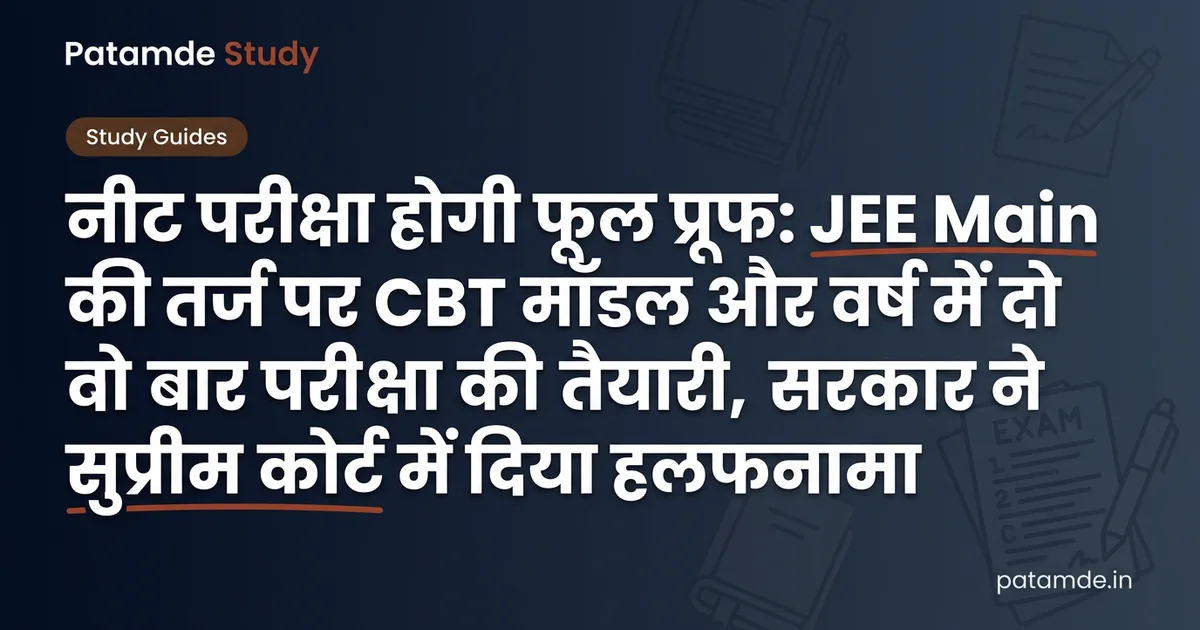
The Central Government has taken a historic and revolutionary step regarding the country's largest and most important medical entrance exam, the NEET Exam. Following the recent paper leak controversies and questions raised over the functioning of the National Testing Agency (NTA), the government has prepared a new roadmap to make the exam completely secure and "foolproof". Under this new change, plans are being made to transition the exam from the traditional Pen-and-Paper mode to a Computer Based Test (CBT), i.e., online mode, on the lines of JEE Main.
This is not just a technological change, but a major policy step towards securing and making transparent the future of millions of medical aspirants in the country. Under this new model, students will not only get a secure exam environment, but any scope of malpractice or paper leaks in the exam will be completely eliminated. For every minor and major update on the new format and upcoming changes of this exam, you can rely on Patamde Study, which always keeps you updated with the right and precise exam strategies.
Central Government's Affidavit in the Supreme Court: What are the New Proposals?
In response to petitions seeking structural reforms in the NTA and making the exam more secure, the Central Government has filed a detailed affidavit in the Supreme Court. This affidavit has been presented on behalf of Under Secretary Arvind Kumar Sinha in the Department of Higher Education, Ministry of Education. In this affidavit, the government has clarified that they are fully committed to making the NEET UG exam more transparent and leak-proof.
The main proposals of this affidavit are as follows:
- Adopting the Computer Based Test (CBT) Model: The government is seriously considering transitioning the NEET UG exam completely to an online CBT model, just like the JEE Main exam is conducted.
- Exam Twice a Year: To reduce students' stress and provide them with better opportunities, plans are underway to conduct the exam twice a year.
- Phased Transition: Instead of implementing this change abruptly, it will be rolled out in a phased manner. Initially, adopting it as a two-stage model is being considered so that rural and female candidates get adequate time to prepare.
- Consent from Allied Ministries: Any structural change in the design or mode of the exam will be finalized only after the consent and consultation of the Ministry of Health and Family Welfare and the National Medical Commission (NMC).
3 Most Important Steps Taken by the Government So Far
To fix this entire system, the Central Government is not just limited to planning, but several important steps have also been taken on the ground. According to the affidavit presented in the Supreme Court, the government has taken three major and strict decisions so far:
1. Implementing Strict Laws
The government has implemented the Public Examinations (Prevention of Unfair Means) Amendment Act, 2026. Under this law, extremely strict penalties and fines have been provisioned to prevent the use of unfair means, paper leaks, and cheating in public examinations. It also includes provisions for setting up Fast-Track Courts for the speedy trial of such cases.
2. High-Powered Task Force Chaired by Nandan Nilekani
A High-Powered Task Force was constituted on June 27 for technological and structural reforms in the examination system. The chairman of this task force is Infosys co-founder Nandan Nilekani. This task force is conducting an in-depth review of exam reforms and will submit its detailed recommendations to the government within three months.
3. Comprehensive Security Framework by Dr. Radhakrishnan Committee
A High-Level Committee of experts was constituted under the chairmanship of former ISRO Chairman Dr. K. Radhakrishnan. Under the supervision of this committee, an extremely comprehensive and modern exam security system has been prepared, securing every stage from the printing of question papers to their distribution and evaluation.
Here is a brief overview of these steps taken by the government:
| S.No. | Steps Taken by the Government | Main Objectives & Provisions | Leadership/Chairmanship |
|---|---|---|---|
| 1 | Public Examinations Amendment Act, 2026 | Provision for strict punishment, heavy fines, and Fast-Track Courts | Central Government |
| 2 | High-Powered Task Force | Use of modern technology and AI in exams, recommendations in 3 months | Nandan Nilekani (Infosys Co-founder) |
| 3 | High-Level Expert Committee | End-to-end security audit and foolproof distribution system | Dr. K. Radhakrishnan (Former ISRO Chairman) |
Challenges and Opportunities in Transitioning from Offline Pen-and-Paper to CBT (Computer Based Test)
Moving the NEET UG exam from pen-and-paper mode to online CBT mode is a massive administrative and technological task. This transition comes with its own unique opportunities and challenges:
Challenges:
- Massive Number of Candidates: Every year, more than 2.2 million (22 lakh) students appear for the NEET UG exam. Arranging computers and secure exam centers on such a large scale is a major challenge.
- Situation of Rural and Female Candidates: According to the government, a large portion of the students appearing for the exam consists of students from rural areas and female candidates. It will be essential to make them digitally literate and comfortable with computer-based testing.
- Digital Infrastructure: Ensuring the availability of high-speed internet and secure servers across every corner of the country without any technical glitches will be the most crucial task.
Opportunities:
- Zero Possibility of Paper Leaks: In CBT mode, question papers are sent directly from the server to the exam center computers shortly before the exam begins, completely eliminating the risk of paper leaks during printing and transportation.
- Transparent Evaluation: In online exams, human intervention is minimized, making the results completely accurate and error-free.
- Easier for Students: Students will be saved from making mistakes while filling bubbles in OMR sheets. If they wish to change the answer to any question, they can easily do so on the computer screen.
Role of Expert Committees in Exam Reforms
The government has clarified that any hasty decision regarding the examination system will not be in the best interest of the students. Therefore, all decisions are being taken solely based on the recommendations of expert committees.
The task force led by Nandan Nilekani is focusing on how to utilize modern digital technologies, Artificial Intelligence (AI), and robust administrative rules in the examination process. Meanwhile, Dr. K. Radhakrishnan's committee has already given several key suggestions to strengthen data security, exam center infrastructure, and the internal organizational structure of the NTA.
Key Takeaway: The primary objective of the Central Government is to build a robust system that is not only technologically secure but also accessible and equitable for students living in the most remote areas of the country. Before implementing any changes, students will be given adequate advance notice to prepare.
How Will the New NEET Exam Pattern Affect Students' Preparation?
If the government takes the final decision to transition NEET UG to CBT mode, students will also have to make some important changes in their preparation strategy:
- Practice Online Mock Tests: Instead of filling OMR sheets, students will now have to get used to taking exams on a computer screen. For this, solving as many online mock tests as possible will be essential.
- Time Management: The speed of reading and solving questions on a computer screen differs from offline exams. Students will need to become comfortable with screen-reading and using a keyboard and mouse.
- Benefit of Exams Twice a Year: If the exam is conducted twice a year, the mental pressure on students to perform well in a single attempt will be significantly reduced. They will be able to correct their mistakes and score better in the second attempt.
For this changing pattern and the best preparation for the exam, you can seek help from the study materials and strategies available on Patamde Study. We will fully assist you in adapting to the new exam pattern and sharpening your preparation.
Conclusion: A Major Step Towards a Transparent and Secure Future
The Central Government's affidavit filed in the Supreme Court regarding reforms in the NEET UG exam is proof that the government is highly serious about restoring the credibility of the exam. Adopting the CBT model on the lines of JEE Main and planning to conduct the exam twice a year will certainly prove to be a major and positive step in the interest of students. However, to implement this change smoothly, the government will have to pay special attention to the infrastructure in rural areas.
As a student, your focus should solely be on your studies and practice. Keep yourself updated with the changing pattern and move your preparation in the right direction.
If you too are preparing for the upcoming NEET Exam and are looking for the latest exam updates, detailed study guides, and the best strategies, visit Patamde Study today. We are with you at every step of your journey to success!