What is a Staffing Pattern? Rules, Process, and Importance in Education
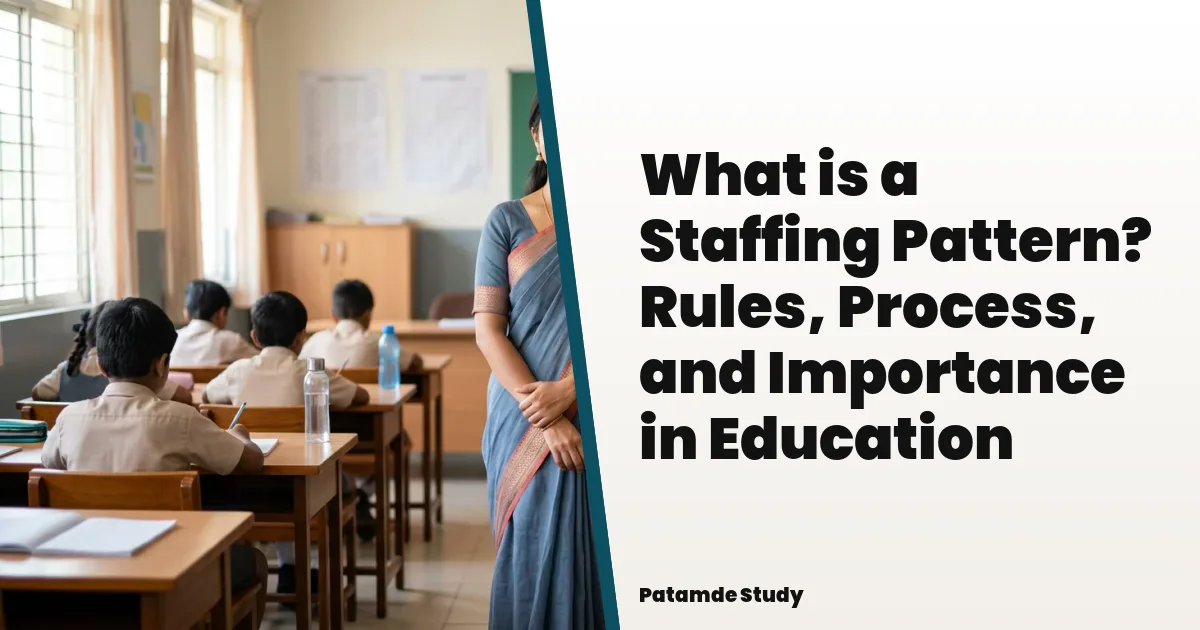
What is a Staffing Pattern? Its Rules, Process, and Importance in the Education Department
To run any organization or government department smoothly, it is essential to have the right number of employees with the right qualifications. The process of ensuring this arrangement is called a Staffing Pattern. This term is highly popular, especially in the Education Department, where the determination of teacher posts in schools is done in proportion to student enrollment.
In this article, we will understand the meaning of a staffing pattern, its rules, its importance in the education department, and the complete process of adjusting surplus teachers in a simple and detailed manner.
Meaning of Staffing Pattern
The direct meaning of a Staffing Pattern is—"creation, classification of posts, and correct allocation of employees according to the needs and rules of the organization."
In the context of the education department, based on the number of students currently studying (enrollment) in a school, it is decided how many teachers of which subject, headmasters, or other staff should be there. If the number of students in a school increases, new posts are sanctioned; and if the student strength decreases, the additional posts are abolished and the teachers are transferred elsewhere.
Why is a Staffing Pattern Needed in the Education Department?
Under the Right to Education Act (RTE Act), it is mandatory to maintain a specific Pupil-Teacher Ratio in primary and upper primary schools. The staffing pattern works to balance this ratio.
Its main objectives are as follows:
- Proper Utilization of Resources: No school should have too many teachers compared to the students, nor should any school face a shortage of teachers.
- Transparency: Information regarding the sanctioning of posts and vacancies is made available transparently through online portals like Shala Darpan.
- Reorganization of Posts: New posts are created from time to time when schools are upgraded.
- Paving the Way for New Recruitment: When a new staffing pattern is implemented, the actual details of vacant posts come to light, which opens the way for new appointments and DPC (Departmental Promotion Committee) for unemployed youth.
General Rules of Pupil-Teacher Ratio and Staffing Pattern
The determination of teacher posts at the primary and upper primary levels is generally done according to the following rules:
Staffing Pattern at Primary Level (Classes 1 to 5)
| Student Enrollment | Number of Sanctioned Teachers |
|---|---|
| 1 to 30 students | 1 Teacher |
| 31 to 60 students | 2 Teachers |
| 61 to 90 students | 3 Teachers |
| 91 to 120 students | 4 Teachers |
| 121 to 150 students | 5 Teachers |
| More than 150 students | 5 Teachers + 1 Headmaster (HM) |
Staffing Pattern at Upper Primary Level (Classes 6 to 8)
At the upper primary level, subject-wise teachers (Mathematics/Science, Social Science, English, Hindi, and Third Language) are appointed. In addition, physical education teachers (PTI) and institution heads are decided based on enrollment.
Important Note: At the secondary and senior secondary levels (Classes 9 to 12), a minimum enrollment (e.g., a minimum of 25 students in Rajasthan) is required for each faculty, based on which the post of Lecturer for that subject is sanctioned.
Surplus Teacher and the Adjustment Process
The biggest challenge when implementing a staffing pattern is the management of surplus teachers.
Who are Surplus Teachers?
When the enrollment of students in a school decreases, the number of sanctioned posts there decreases as per the rules of the staffing pattern. In such a situation, the teachers among the working staff who fall outside the scope of the rules (become extra) are called surplus teachers.
How does the Adjustment take place?
- Determination of Seniority: Generally, the teacher who arrived last in the school (junior-most) is declared surplus first, although the department has its own specific rules for this.
- Counseling Process: Surplus teachers are not removed directly. Counseling is organized by the District Education Officer's office.
- Posting in Vacant Positions: Through counseling, these teachers are sent to vacant posts in schools that face a shortage of teachers.
- Online Upgradation: This entire process is recorded online on Shala Darpan or the respective departmental portal to maintain transparency.
Benefits of Staffing Pattern
- Uniform Education System: It ensures an equal distribution of teachers in schools across rural and urban areas.
- Proper Budget Management: The government gets relief from expenses incurred on unnecessary posts, and the budget is utilized correctly where needed.
- Ease for Teachers: Teachers get an opportunity for transfer or adjustment to the right place through counseling based on their preference and vacancies.
Conclusion
A staffing pattern is the backbone of any efficient administrative and educational framework. It not only addresses the shortage of teachers in schools but also brings qualitative improvement to the education system. It is also essential for candidates preparing for competitive exams to understand the staffing pattern, as the blueprint for future vacancies and new teacher recruitments is prepared based on this.
If you are also preparing for various government teacher exams (such as REET, 1st Grade, 2nd Grade, or other state-level TETs), you can use Patamde mock tests and study material to strengthen your preparation, where you will find excellent study material based on the latest syllabus.