Major NTA Reforms: 600 Experts Removed, 4-Tier Paper Checking and CISF Security Implemented
Super Admin··6 min read
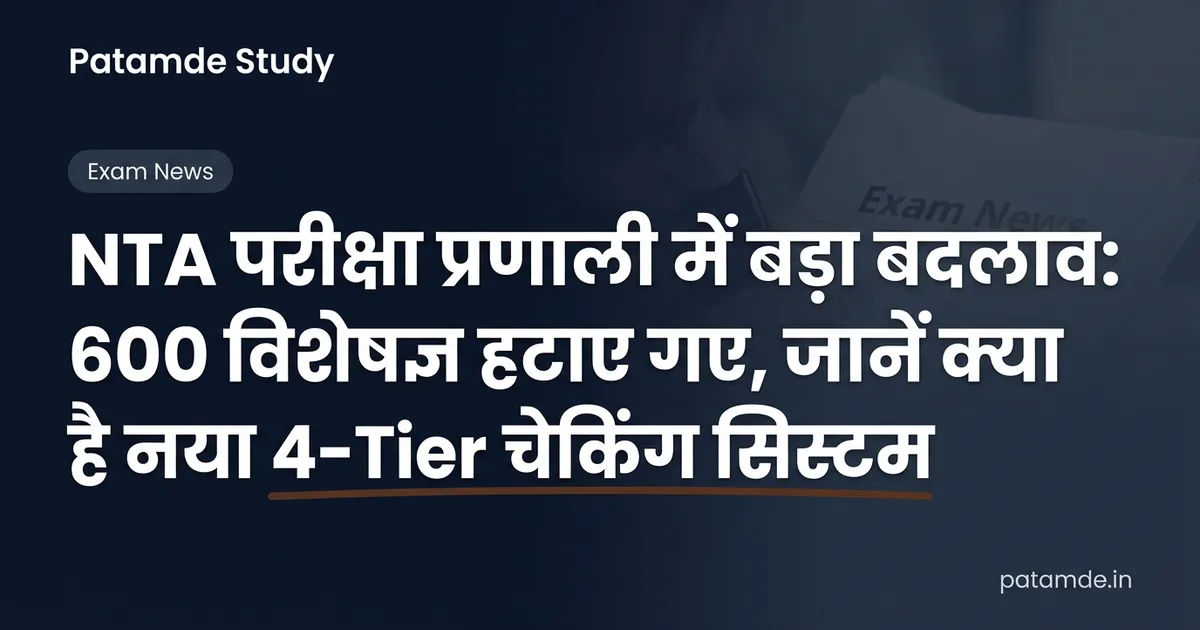
Recently, the Central Government and the Union Ministry of Education have decided to implement the biggest and most historic reform yet in the NTA examination system (National Testing Agency). NTA, the agency responsible for conducting the country's largest exams such as NEET-UG, JEE-Main, CUET, and UGC-NET, had recently been mired in allegations of paper leaks and technical glitches. To root out these problems and regain the trust of crores of students across the country, the government has introduced radical changes to the examination system. Under this new reform, approximately 600 experts have been shown the door from NTA's paper-setter panel, and a new team is being formed in their place.
The list of these changes was released following a high-level review meeting chaired by Union Education Minister Pralhad Joshi. In this article, we will explore in detail the changes made in this new NTA system and how they will impact future competitive examinations.
600 Experts Dismissed: Why Was This Major Decision Taken?
The National Testing Agency (NTA) has removed around 600 professors, teachers, and subject experts from its old question paper preparation panel. This step has been taken to maintain the confidentiality and fairness of the examinations.
- Preventing Leaks and Malpractices: Errors and paper leak cases in exams like NEET-UG and UGC-NET conducted recently had caused a nationwide stir. During the investigation, it was revealed that there were security loopholes at multiple levels in the old system, which anti-social elements exploited to orchestrate paper leaks.
- Fixing Accountability: The Central Bureau of Investigation (CBI) probe report also indicated that safety protocols were not being strictly followed between some paper-setting experts and external elements. Keeping this in mind, the government took the strict decision to replace the entire old team.
- Selection of a New Team: A completely new team of subject experts is now being assembled, which will design question papers in accordance with modern security standards.
This news comes as a relief for students preparing for competitive exams. Experts at Patamde Study (patamde.com) believe that this stringent step will restore the sanctity of the examinations and ensure that deserving candidates reap the full rewards of their hard work.
What is the Four-Tier Question Paper Checking System?
To prevent any kind of human error or technical glitch during future examinations, NTA is now going to implement a Four-Tier Question Paper Checking System. The primary objective of this new system is to make security and surveillance foolproof, from the preparation of the question paper right up to the day of the exam.
The main stages of this four-tier system are as follows:
- First Tier (Question Creation): A large pool of questions will be prepared by the newly onboarded subject experts.
- Second Tier (Review and Moderation): These questions will be meticulously scrutinized by independent domain experts and psychometricians. This will test language clarity, accuracy, any form of bias, and the difficulty level.
- Third Tier (Independent Solving): Before the question paper is finalized, a separate team of experts and committee members will solve the paper themselves. They will cross-check their answers with the answer key so that no dispute arises regarding any question or answer after the exam.
- Fourth Tier (Statistical Analysis): After the exam concludes and before the final evaluation, the questions will be analyzed by statisticians to identify any erroneous questions in a timely manner.
From Okhla to Minto Road: New Office and Security Handed Over to CISF
To bring transparency to NTA's functioning, changes have been made not only administratively but also geographically and in terms of physical security.
- Relocation of Headquarters: NTA's old office located in Delhi's Okhla Industrial Area is now being relocated on a war footing to the Government of India Press building at Minto Road in Central Delhi.
- Deployment of CISF: Previously, the security of the NTA office was managed by private security agencies, which failed to maintain strict control over the movement of people. Now, the security of the new premises has been completely handed over to the personnel of the Central Industrial Security Force (CISF).
- Strict Confidentiality Rules: Isolated rooms, air-gapped systems, and live CCTV monitoring control rooms are being set up in the new office for question paper preparation and other sensitive tasks. No officer or employee will be allowed to carry mobile phones or any electronic devices into these restricted areas.
Appointment of New Officers and Technical Reforms
To strengthen NTA's internal structure, 20 to 25 new officers will be appointed within the next two to three weeks. Along with this, 10 new professional leadership positions have been created to enhance technical expertise within the agency.
These new technical and administrative positions primarily include:
- Chief Technology Officer (CTO): To strengthen cybersecurity and the technical infrastructure associated with exams.
- Chief Information Security Officer (CISO): To maintain data security and information confidentiality.
- Chief Finance Officer (CFO): To ensure financial transparency.
- General Manager (Test Security): To manage the physical and digital security of exam centers and question papers.
- General Manager (Research & Development and Psychometrics): To improve the scientific standard of question papers and evaluation methodologies.
Domain experts from both private and public sectors are being brought into these positions to transform NTA into a modern and secure testing agency.
Summary of NTA's New Security and Administrative Reforms
Through the table below, you can easily understand the differences between the old and new systems of NTA:
| Parameters | Old System | New System |
|---|---|---|
| Expert Panel | 600 old professors and teachers (who have now been removed) | Team of new subject experts and psychometricians |
| Question Paper Checking | Basic-level checking process | Four-Tier Checking System |
| Headquarters Address | Okhla Industrial Area, Delhi | Minto Road, Central Delhi (New Building) |
| Security Force | Private security agencies (Lax Security) | Round-the-clock tight security by CISF |
| Technical Leadership | Traditional administrative structure | Specialist positions like CTO, CISO, and GM (Test Security) |
| Confidentiality Standards | General security protocols | Air-gapped systems, isolated rooms, and live CCTV monitoring |
Conclusion: What Will Be the Impact on Students' Future?
These major changes implemented in the NTA examination system are certainly in the interest of millions of students across the country. Every year, more than 1 crore students appear for various exams conducted by NTA. Malpractices in exams not only push the future of students into darkness but also adversely affect their mental health.
These strict steps taken by the government will enhance security at exam centers, improve the quality of question papers, and completely curb incidents like paper leaks. Students should now focus on their studies without paying attention to any rumors.
Important Message: To be the first to get the changing patterns of exams, new security rules, and any latest updates related to exams, follow Patamde Study (patamde.com) regularly. Here you will get accurate information, excellent study guides, and test strategies prepared by experts.