CBSE OSM Controversy: Radha Chauhan Committee to Submit Report on August 27, Action Looming Against Officials
Super Admin··8 min read
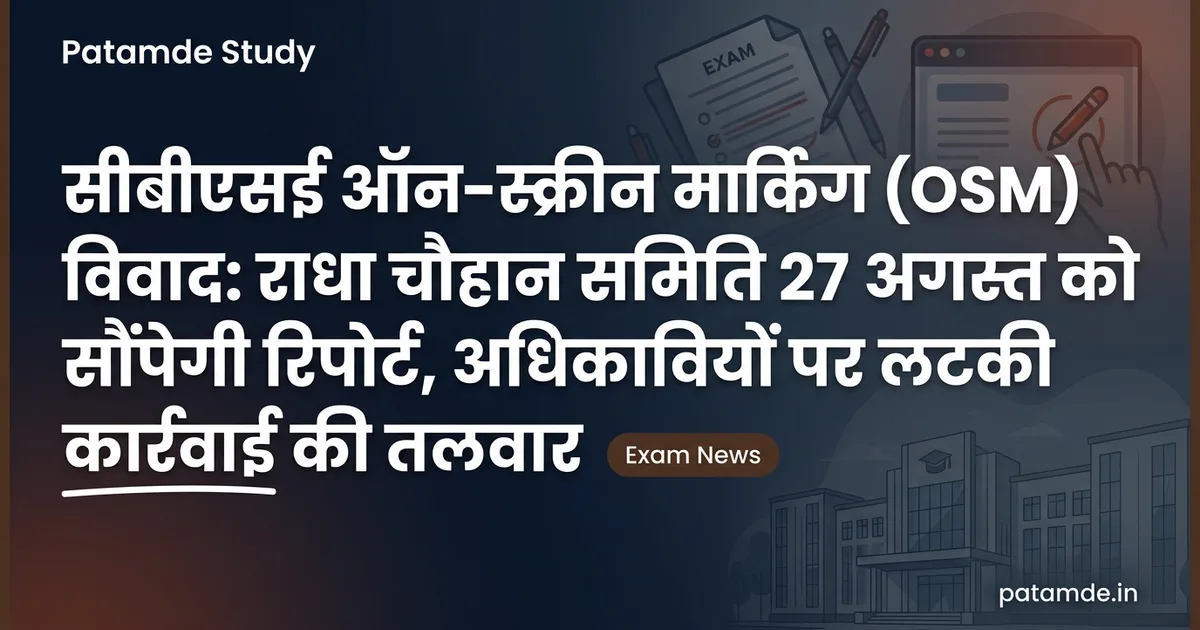
CBSE On-Screen Marking (OSM) Controversy: Radha Chauhan Committee to Submit Report on August 27, Sword of Action Hangs Over Officials
Digitalization and technological reforms in the Indian education system have always been considered a progressive step. In this direction, the Central Board of Secondary Education (CBSE) adopted the On-Screen Marking (OSM) or digital evaluation system for grading Class 12 answer sheets. However, the technology introduced to enhance transparency and accuracy has found itself at the center of controversy this year. Following serious complaints from students, parents, and teachers, the matter has now reached the country's apex court.
The high-level committee constituted by the Central Government to investigate this entire CBSE On-Screen Marking (OSM) controversy is set to submit its final report on August 27. Led by Radha Chauhan, Chairperson of the Capacity Building Commission, this committee will reveal the level of negligence in the digital evaluation and identify the officials responsible. It is believed that, on the lines of the dismissal of 47 National Testing Agency (NTA) employees in the NEET (NEET) paper leak case, strict action could be taken against the guilty CBSE officials as well.
If you are also preparing for the CBSE board exams or have been affected by this system, stay connected with Patamde Study for detailed information and future updates on this entire matter. Let us understand in detail in this article what this controversy is all about, what points are covered in the Radha Chauhan committee's investigation, and how it will impact the 2027 board exams.
What is the On-Screen Marking (OSM) System and Why Was It Implemented?
On-Screen Marking (OSM) or the digital evaluation system is a technology under which students' physical answer sheets are first scanned using high-quality scanners. Subsequently, these scanned digital copies are uploaded to a secure online portal. Teachers evaluate these digital copies on computer screens from their homes or centralized evaluation centers and enter the marks directly into the system.
CBSE had implemented this system with the following objectives:
- Reducing human errors: In traditional evaluation, mistakes often occurred during the totaling of marks, which the digital system completely eliminates.
- Faster results: With digital evaluation, marks data is saved directly to CBSE's main database, significantly reducing the time taken to declare results.
- Transparency and tracking: Through this system, it can be easily tracked how much time a teacher took to evaluate a particular answer sheet.
This year, CBSE digitally evaluated approximately 9.8 million answer sheets of Class 12 through this OSM system. However, implemented on such a large scale for the first time, this system exposed several serious technical and administrative loopholes, casting a shadow of doubt over the entire process.
The Main Cause of the Controversy: Where Did It Go Wrong?
Ever since the declaration of the CBSE Class 12 results, widespread anger has been witnessed among students and parents across the country. Many meritorious students complained that they received far fewer marks than expected. When students requested copies of their answer sheets, the flaws of this digital system were exposed.
The following major discrepancies came to light in the evaluation process:
- Swapped and missing pages: Many students complained that crucial pages of their answer sheets were either missing or swapped with pages from another student's copy.
- Un-scanned pages: In several cases, some pages of the answer sheets were not scanned at all, leading to those answers being left unevaluated and resulting in zero marks for those questions.
- Blurry and unclear scanning: The scanned copies were so blurry that it was extremely difficult for teachers to read and evaluate them properly.
- Lack of teacher training: Teachers evaluating the copies were not provided with adequate and formal training to use this new digital portal, which affected the quality of evaluation.
These technical and administrative shortcomings had a direct impact on the future of the students. The marks of many students dropped so low that they failed to meet the minimum eligibility criteria (such as 75% marks) required for admission to various universities and professional courses, despite clearing the entrance exams. Consequently, the passing percentage for Class 12 this year plummeted to a seven-year low of 85.2%.
Who is S. Radha Chauhan and What is the Role of This Committee?
Following this large-scale discrepancy and widespread protests, the Central Government took swift action in June 2026 by transferring the then CBSE Chairman Rahul Singh and Secretary Himanshu Gupta. Along with this, a high-level, one-member committee was constituted to conduct an in-depth investigation into the entire matter.
The command of this committee has been handed over to S. Radha Chauhan. Radha Chauhan is a highly respected and experienced retired IAS officer of the 1988 batch from the Uttar Pradesh cadre. She retired as the Secretary of the Department of Personnel and Training (DoPT), Government of India, and is currently serving as the Chairperson of the Capacity Building Commission. Given her extensive experience in digital governance and administrative reforms, she has been entrusted with the responsibility of this sensitive investigation.
The key investigation points of the Radha Chauhan Committee are as follows:
- What were the irregularities in the procurement process of technical services and software for the OSM system?
- Which external agencies or officials are responsible for the technical glitches and scanning errors?
- Was the security and confidentiality of the answer sheets compromised?
- What corrective measures can be taken to prevent such technical errors in the future?
Traditional Evaluation vs. On-Screen Marking (OSM): A Comparative Analysis
Refer to the table below to better understand the advantages and disadvantages of the digital evaluation system:
| Parameter | Traditional Evaluation | On-Screen Marking (OSM) |
|---|---|---|
| Method of Evaluation | Teachers evaluate physical answer sheets using a red pen. | Teachers evaluate digitally scanned copies on a computer screen. |
| Calculation of Marks (Totaling) | Totaling of marks is manual, leaving room for human error. | Marks are automatically added by the computer, eliminating calculation errors. |
| Technical Dependency | Minimal technical dependency. | High technical dependency (high-speed scanners, internet, and server security). |
| Transparency and Security | Risk of copies getting lost or torn, but lower chances of pages being swapped. | Digital copies remain secure, but there is a risk of poor scanning and missing pages. |
| Teachers' Experience | Teachers have been accustomed to this system for decades, so no special training is required. | Teachers require special training to work on computers, which was lacking this time. |
Preparations for Strict Action on the Lines of the NEET Case
Recently, taking a tough stance in the NEET paper leak case, the government dismissed 47 NTA employees. This strict step sent a clear message that those playing with the sanctity of exams and the future of students will not be spared.
In this CBSE case as well, the government appears to be in the mood for similar strict action. The Radha Chauhan Committee report is scheduled to be submitted to the government on August 27. Based on this report, the level of negligence will be determined, and action is highly likely against all those officials and external vendors (agencies) who showed laxity in implementing this system. According to sources, several major and historic changes could be seen in CBSE's administrative structure after the submission of this report.
Will OSM Continue in the 2027 Board Exams?
The biggest question in the minds of students and parents is whether the evaluation of answer sheets in the upcoming 2027 board exams will also be done through this digital medium.
The Radha Chauhan Committee report will play the most crucial role in answering this question. The report will decide:
- Whether the current OSM system should be completely scrapped and replaced by a return to traditional manual evaluation?
- Or should this system be continued with strict security rules, better infrastructure, and comprehensive training for teachers?
Apart from this, the Supreme Court is also keeping a close watch on this matter. The court has given clear instructions to CBSE to protect the interests of students until this system is made completely secure, and to ensure that no student's academic year is ruined due to technical glitches.
Conclusion: What Will Be the Impact on Students' Future?
The CBSE On-Screen Marking controversy has proven that implementing any new technology in the education sector without adequate preparation, testing, and security audits can prove disastrous. Years of hard work and the careers of students cannot be sacrificed due to a few technical glitches or administrative negligence.
The Radha Chauhan Committee report, coming on August 27, will not only fix accountability for the guilty officials but will also determine the future direction of digital evaluation in India. It is hoped that the government and CBSE will learn from this entire episode and develop a system that is completely secure, transparent, and student-friendly.
Keep visiting Patamde Study regularly for the most reliable and accurate analysis of CBSE board exams, exam strategies, and every news update from the education sector. Strengthen your preparation and stay updated with any new changes.